
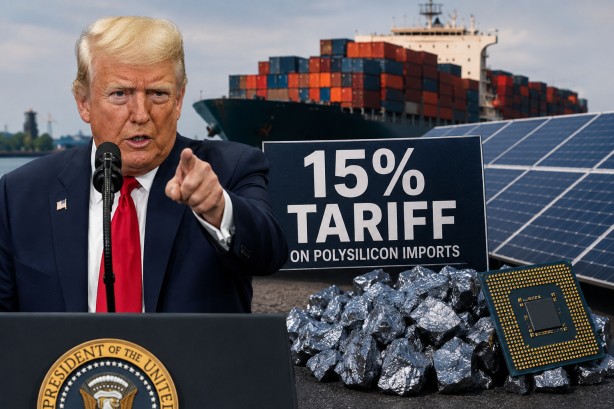
In a move aimed at bolstering domestic production and reducing dependency on China, US President Donald Trump has announced a new 15% tariff on imported products that utilize polysilicon. This tariff, set to be enforced from December 4, targets a crucial material used extensively in the manufacture of semiconductors and solar panels. Polysilicon, an ultra-pure form of silicon, is essential in powering artificial intelligence systems, data centers, and solar energy solutions. With China currently being the dominant global producer, this policy shift seeks to strengthen the United States’ supply chain and enhance its economic and national security.
The new trade measures include specific minimum import prices: $21 per kilogram for polysilicon, $100 per kilogram for polysilicon ingots and wafers, $0.22 per watt for solar cells, and $0.38 per watt for solar modules and panels. According to the US administration, these actions are designed to support the viability of domestic polysilicon production and ensure that critical supply chains remain robust. In addition, the policy allows for the establishment of incentives aimed at encouraging investment in domestic manufacturing facilities related to polysilicon.
The response from China has been critical, with officials accusing the United States of misusing national security concerns to unfairly limit Chinese business interests. They warn that such protectionist measures could lead to disruptions in trade relations between the two economic giants. Despite these tensions, the US currently maintains two significant polysilicon production facilities, operated by Hemlock Semiconductor in Michigan and Wacker Chemie in Tennessee.
This tariff imposition comes amid China’s continued growth in exports, particularly in electronics, artificial intelligence products, and other high-value manufacturing sectors. As the global market for these technologies expands, the US is seeking to position its domestic industries to better compete and thrive independently from foreign materials, particularly those sourced from China.