
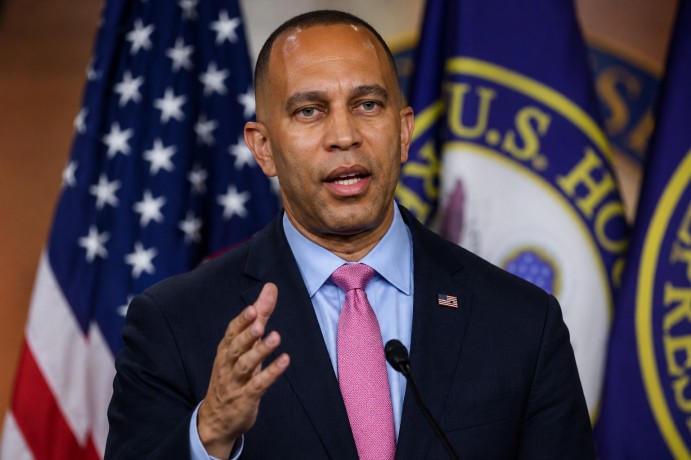
In a significant development, senior Democrats in the House have announced their intention to oppose a proposal that aims to halt $3.3 billion in U.S. aid to Israel. This move underscores the growing divisions within the Democratic Party regarding support for Israel. House Minority Leader Hakeem Jeffries has expressed his disapproval of the amendment put forward by Republican Representative Thomas Massie, labeling it as “overly broad.” Jeffries warned that the proposal might inadvertently disrupt humanitarian aid and weaken efforts to counteract militant groups like Hamas and Hezbollah.
Similarly, House Democratic Caucus Chair Pete Aguilar has voiced opposition to the measure, although he acknowledges the necessity for a reassessment of U.S.-Israel relations. Aguilar pointed out that Israel’s current policies have resulted in increased regional isolation. This sentiment is shared by other party members who are calling for a reevaluation of the longstanding alliance.
On the other hand, Greg Casar, Chair of the Congressional Progressive Caucus, has encouraged lawmakers to back the amendment. He argues that U.S. taxpayer money should cease funding Israel’s military operations and advocates for the Democratic Party to adopt a fresh approach to the Israel-Palestine issue. Casar’s stance reflects the growing pressure from voters and progressive legislators who are demanding changes in U.S. policy towards Israel, especially in light of the ongoing conflict in Gaza.
In a broader call for change, Jeffries has advocated for a “major reset” in U.S.-Israel relations. While affirming Israel’s right to exist, he has also championed the establishment of a Palestinian state. Jeffries suggested that future U.S. military assistance should adhere to human rights standards and consider Israel’s capacity to finance more of its own defense. This perspective indicates a potential shift in how U.S. support to Israel might be structured moving forward.