
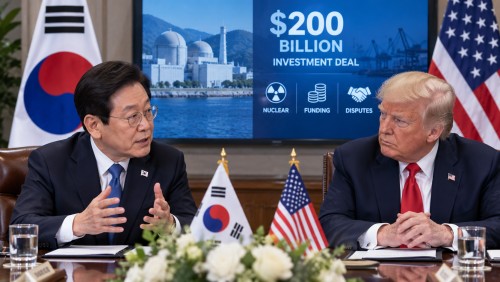
The ongoing negotiations between South Korea and the United States over a significant investment package face critical challenges that could delay or alter Seoul’s planned $200 billion commitment in the US. The discussions are currently hindered by divergent views on nuclear projects, funding timelines, and investment risk-sharing, raising uncertainty around the final agreement.
One of the most contentious issues centers around nuclear reactor designs. The two nations are contemplating the construction of eight reactors in the US, but disagreements have emerged over the inclusion of South Korea’s APR1400 technology. While South Korea is keen on integrating its design alongside Westinghouse’s AP1000, opposition from US officials and Westinghouse complicates reaching a consensus. This dispute threatens to impact the allocation of potentially $120 billion towards nuclear-related projects, a significant portion of South Korea’s commitment.
In addition to technological disagreements, financial and ownership stakes also pose significant hurdles. South Korea is negotiating a 15% to 20% stake in Westinghouse, seeking voting rights and a board seat, while Westinghouse prefers limiting Seoul’s ownership to less than 10%. These ownership terms are crucial as they influence control and influence over the projects.
Further complicating the negotiations are differing views on funding schedules and profit-sharing arrangements. The US has requested over $9 billion from South Korea by the end of this year, while Seoul had initially planned to start with a smaller sum in 2026, increasing investments from 2027. Additionally, South Korea advocates for a system where profits from successful ventures offset losses from unsuccessful ones, contrary to the US approach of individual project accounting.
While both nations are committed to finalizing the details, the complexity of the issues at hand suggests that reaching a mutually agreeable framework might take more time. South Korea’s Industry Ministry has stated that discussions are ongoing, with no definitive decisions made regarding the projects, funding structures, and investment arrangements.