
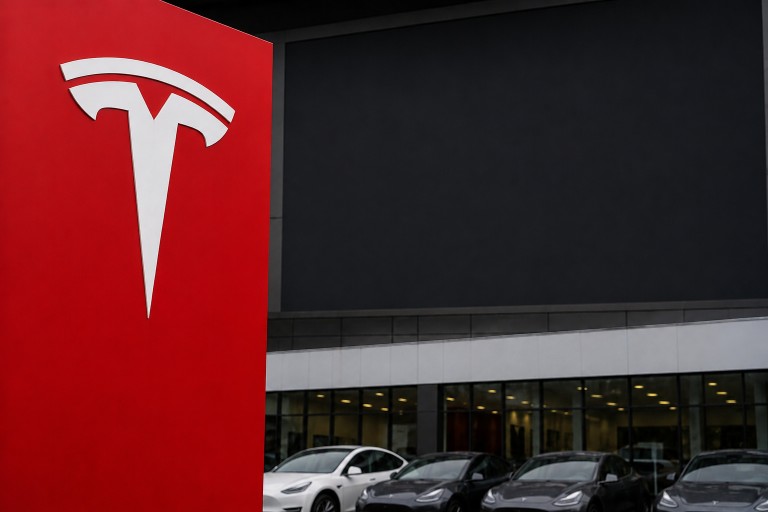
Tesla’s latest financial report revealed a mixed performance for the second quarter, as the company surpassed revenue expectations but fell short on profits, leading to a decline in its share price. Tesla reported earnings of 31 cents per share, which missed Wall Street’s projection of 51 cents, despite achieving higher-than-anticipated revenue of $28.23 billion, exceeding the forecasted $25.71 billion. This discrepancy resulted in a more than 3% drop in the company’s shares during after-hours trading.
The electric vehicle giant has seen a 14% decrease in its stock value this year, influenced by growing competition from more affordable Chinese electric vehicle manufacturers and the repercussions of the expiration of U.S. electric vehicle tax incentives. Despite these challenges, Tesla is actively shifting its strategic focus beyond vehicle sales, increasingly emphasizing advancements in artificial intelligence, robotics, autonomous driving, and its emerging Robotaxi service.
CEO Elon Musk highlighted the potential of the Optimus humanoid robot, suggesting it could eventually become Tesla’s most significant product. However, he acknowledged that significant technical and manufacturing hurdles must be addressed before large-scale production can be realized. This shift aligns with Tesla’s broader vision of integrating innovative technologies into its offerings.
In terms of autonomous transportation, Tesla is expanding its Robotaxi service, with recent extensions to Tampa and Orlando. This service is already operational in selected areas of Austin, Dallas, Houston, and Miami, reflecting the company’s cautious yet determined expansion strategy. Musk emphasized that the Robotaxi rollout is being approached with a careful focus on safety to prevent incidents that might attract regulatory scrutiny.
Currently, around 50 Robotaxis are in operation in Austin, marking the initial launch site for this service. The cautious expansion underscores Tesla’s commitment to balancing innovation with regulatory compliance, as the company navigates the complexities of autonomous vehicle deployment amid a competitive and rapidly evolving market landscape.